Today, the Earth is facing Libra.
In astronomy, the solar sign corresponds to the constellation opposite the Earth: when the Sun is between the Earth and a constellation, that is the one seen behind the Sun. In mid-March, the Sun is therefore in Pisces, and Libra is on the night side.
☀️ The Sun
The Sun is at the centre of the solar system. The Earth orbits it in 365.25 days.
Seen from Earth, the Sun appears to pass through each constellation throughout the year — this is what is called the ecliptic.
Your astrological sign corresponds to the constellation in which the Sun was located on the day you were born.
Ophiuchus · 13th Zodiac Sign
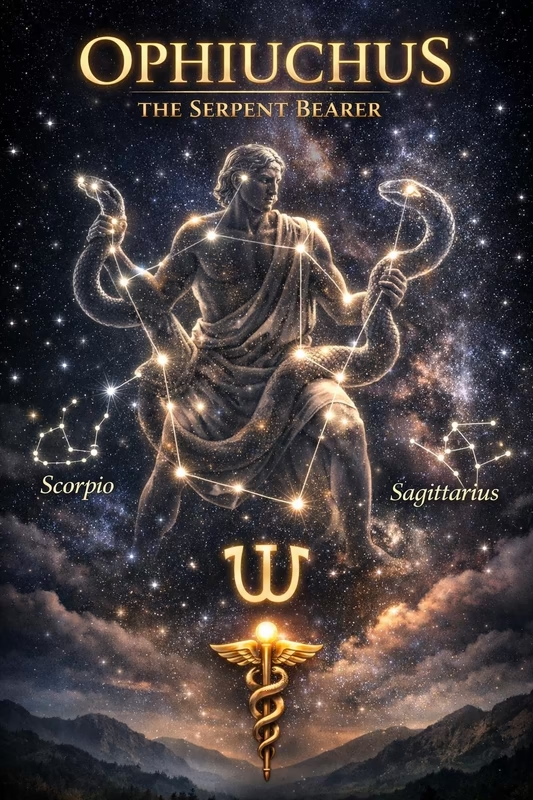
The Serpent Bearer ⛎︎, the 13th zodiac sign omitted from the horoscope
Enter your date of birth to discover whether your horoscope is altered by Ophiuchus.
✦ In brief
The Western zodiac has 12 signs. The sky, however, has 13 with Ophiuchus, the Serpent Bearer, who was deliberately excluded. We will explore why and examine the astrological consequences.
Preamble
From Sagittarius to Serpent Bearer
For years, I held the quiet belief that I was a Sagittarius. Fire. Idealism. Philosophy. Adventure. The archetype fitted me like a borrowed coat — comfortable, but not quite the right size. And then, another possibility appeared.
On December 9th, when I was born, the Sun was not passing through the constellation of Sagittarius but through Ophiuchus (the Serpent Bearer), a neighbouring constellation that has been omitted from the astrological system.
This is not a definitive truth — it is an open door towards another reading of my cosmic nature.
« The zodiac is not the sky. It is a map of the sky. And every map chooses what it depicts — and what it erases. »
— Richard Hinckley Allen, Star Names: Their Lore and Meaning, 1899 [2]
This is not a conspiracy. It is something deeper: a choice made 2,500 years ago that endures without being questioned, because it is convenient, because it is beautiful, because twelve divides more neatly than thirteen.
✦
I — The reality of the sky
What astronomers know and astrologers keep silent
The ecliptic is the apparent path of the Sun in the sky, as seen from Earth. It is the route around which the zodiac is organised. And that route passes through not twelve, but thirteen constellations.[3]
Two systems that have diverged for 2,000 years
A constellation is a real region of the sky — a group of stars you can observe. An astrological sign is a symbolic division of time, modelled on the 12 months of the Babylonian calendar. Originally, the two roughly coincided. Today, they no longer correspond.
In 1922, the International Astronomical Union established the boundaries of 88 official constellations covering the entire celestial vault — of which 13 are crossed by the Sun. These 13 constellations form the astronomical zodiac: a band of the real sky, used by astronomers to chart the heavens and locate planets. The astrological zodiac, meanwhile, remains fixed at 12 signs of 30° each — regardless of what the sky actually shows.
Constellation
Astrological Sign
Real group of stars
Symbolic zodiac division
Variable size
Fixed 30° segments
13 zodiacal constellations
12 signs
Map of the observable sky
Symbolic seasonal system
« The Babylonians knew of Ophiuchus, but preferred the symmetry of the duodecimal system over the rigour of observation. »
— Bartel L. van der Waerden, Science Awakening II: The Birth of Astronomy, Springer, 1974 [4]
A one-month shift — and nobody told you
The zodiac was originally a Babylonian concept: astronomers of the time divided the Sun's path into 12 segments of 30°, matching the 12 months of their calendar. These segments were named after the constellations that then occupied them. Transmitted by the Greeks — notably Ptolemy in the 2nd century AD — this system became the foundation of Western astrology. The problem: it has not been updated since.
The Earth wobbles — the sky drifts
The Earth is not a perfect sphere: flattened at the poles, bulging at the equator, it slowly wobbles under the gravitational pull of the Moon and Sun, tracing a cone of 23.5° over approximately 25,800 years. This motion — the precession of the equinoxes — gradually shifts the constellations by approximately 1° per human lifetime. The result: astrological dates fixed two millennia ago are today roughly one month ahead of the actual sky.
The Sun enters the astronomical Aries around April 19th — while the astrological sign of Aries begins on March 21st. Most people who believe themselves to be Aries were actually born under Pisces.
Constellations of very different sizes
The 12 signs divide the sky into perfectly equal slices. The real constellations, however, have very different shapes and areas: Virgo covers 1,294 square degrees — the Sun spends approximately 45 days there. Scorpius covers only 497 — the Sun passes through it in only 7 days. Between the two sits Ophiuchus, traversed by the Sun for 18 days and made entirely invisible by the astrological zodiac.
Astrologers respond by clarifying that they use the tropical zodiac, anchored on the seasons rather than on the stars — deliberately disconnected from the physical sky. You decide whether you are Aries or Pisces — Sagittarius or Ophiuchus.
A mathematical choice, not an observational error
Ophiuchus is not a recent discovery. It is one of the 48 constellations catalogued by Ptolemy in the Almagest in the 2nd century AD — the Babylonians knew it perfectly well. They made the deliberate choice to ignore it.
Their goal: to divide the sky into 12 equal portions of 30° to align the zodiac with the 12 months of their calendar. Twelve is a remarkable number — divisible by 2, 3, 4 and 6 — which allowed for an elegant system: four elements, three modalities, twelve perfectly distributed signs. Thirteen is a prime number. Thirteen resists. Thirteen does not divide.
Ophiuchus was therefore ignored — even though the Sun passes through it between late November and mid-December, that is longer than Scorpius, which it crosses in only 7 days. Its imposing silhouette — a man holding a serpent — extends between Scorpius to the west and Sagittarius to the east. This is no minor intruder. It is a giant we have been taught not to see.
A fundamental disagreement between the Moon and the Sun
A solar year lasts 365.25 days. A lunar cycle lasts 29.5 days. Twelve lunations give 354 days — 11 days fewer than the solar year. Thirteen give 383 — 18 too many. No whole number of lunar months lands exactly right. This disagreement forced every civilisation to invent compromises — and explains why almost all of them at some point resorted to a 13th intercalary month.
The names of our months are a 2,700-year anomaly
The primitive Roman calendar had ten months, with the year beginning in March. Their Latin names still betray this origin: September comes from septem ("seven"), October from octo ("eight"), November from novem ("nine"), December from decem ("ten"). The winter months were simply not counted — the official year lasted 304 days, the rest being a nameless floating period.
In the 7th century BC, King Numa Pompiliusadded January and February. When they were moved to the start of the year, the old names remained unchanged — September became the 9th month of a twelve-month year, an anomaly we still carry without thinking.
In 46 BC, Julius Caesar imposed a radical reform: 365 days, a leap year every four years. The transitional year — the annus confusionis — lasted 445 days. In 1582, Gregory XIII corrected the 10 days of accumulated error over sixteen centuries and refined the leap year rule: only centennial years divisible by 400 qualify. The year 2000 was one; 1900 was not.
✦
II — Astronomical and calendar traditions around the world
The Western 12-sign zodiac is just one model among many. Some cultures divide the sky into 27 or 28 sections, others add a 13th month in certain years, others still combine multiple cycles. The sky is the same for everyone — each civilisation has interpreted it differently according to its agricultural, religious and mathematical constraints.
First known calendrical monument, well before the invention of writing, the site of Nabta Playa (Nubian desert, Egypt) contains the oldest known astronomical monument in the world, predating Stonehenge by ~2,000 years. Its circle of megaliths marked the summer solstice, signalling the start of rains and the Nile flood.
The nakshatras — 27 lunar sectors of 13.3° each — are mentioned in the Vedas, whose composition is estimated between 4000 and 1500 BC depending on the source. This lunar zodiac is considered the oldest known zodiacal system, predating the Babylonian solar zodiac. Each nakshatra corresponds to a sector of sky traversed by the Moon in approximately 21 hours — a system faithful to the real positions of the stars, independent of seasons.
First known written calendar, centred on the city of Nippur. Each Sumerian city had its own calendar — months were named after local religious festivals and agricultural tasks, with the appearance of the 13th intercalary month (iti dirig, "in addition").
It was the Nippur calendar that Hammurabi of Babylon (~1792 BC) imposed on all of Mesopotamia. Babylon did not create a new system — it standardised and centralised that of Sumer. The mathematical standardisation of intercalation appeared under the Persian kings, around 380 BC.
365 fixed days. The 5 off-calendar days — epagomenal — were dedicated to the births of Osiris, Horus, Seth, Isis and Nephthys. The New Year was announced by the heliacal rising of Sirius, coinciding with the Nile flood.
Babylon retains the 12 zodiac signs of 30° each. Standardisation of the intercalary month insertion cycle via the Metonic cycle (7 additional months over 19 years).
An intercalary month is added every 2–3 years according to the Metonic cycle, giving some years 13 lunar months. Officially adopted in Japan in 604 AD under Empress Suiko.
Based on lunar months of 29 days alternating with 30-day months. An additional month (Adar II) is intercalated 7 times over a 19-year cycle.
Year 1 of the Hebrew calendar corresponds to 7 October 3761 BC, the date of the world's creation (anno mundi) according to the Old Testament, retrospectively fixed by rabbis in the 2nd century AD. The calendar in its current form was codified around 358 AD by the patriarch Hillel II. It uses the same intercalation cycle as the Babylonian calendar — 7 additional months over 19 years (Metonic cycle). We are currently in the year 5786 of this calendar.
The only major calendar deliberately independent of the seasons. A year of 354 days — Ramadan traverses the entire solar cycle in 33 years, falling in summer as well as winter.
Still in use in the Orthodox Church, today offset by 13 days from the Gregorian calendar — hence Orthodox Christmas on 7 January. Great Britain only adopted the Gregorian calendar in 1752, Russia in 1918.
Despite their differences, these systems share three universal constraints: observation of the sky is inevitable, the lunar cycle is the most immediate reference, and the solar year is essential for agriculture. Almost every civilisation has had to invent an adjustment mechanism — the 13th intercalary month is the most widespread solution. Calendars are not merely technical tools: they reflect the political, religious and cognitive priorities of those who built them.
Date Converter
Hebrew & Gregorian calendar converter
Gregorian date
Hebrew date
Accuracy depends on the objective
The notion of "accuracy" in astronomy is relative to the reference body. No calendar can be perfectly accurate for all cycles simultaneously, because the movements of the Earth, the Moon and the stars are not synchronous.
Most accurate for seasons (Solar): The Gregorian calendar is the champion of the tropical year. With its leap year system, it drifts by only one day every 3,236 years relative to the equinoxes. It is perfect for agriculture, but ignores the Moon.
Most accurate for the Moon (Pure lunar): The Islamic calendar follows synodic cycles with absolute fidelity. Each month begins with the actual observation of the crescent. However, it "loses" approximately 11 days per year relative to the Sun.
Most accurate for star positions (Sidereal): The Indian Vedic system is the most rigorous for locating celestial bodies within constellations. By incorporating the precession of the equinoxes (the slow wobble of the Earth's axis), it remains synchronised with the deep sky, where Western calendars are offset by approximately 23 or 24 degrees — which changes the astrological sign for many, and for some reveals Ophiuchus.
Best compromise (Luni-solar): The Hebrew calendar is a mathematical achievement. Using the Metonic cycle (7 intercalary months every 19 years), it manages to remain faithful to the Moon while landing almost exactly right relative to the Sun.
In summary: If you want to know when to plant your seeds, the solar calendar is the most accurate. If you want to know where the Sun actually is among the stars, the sidereal calendar prevails.
Hundreds of millions of people still consult it daily
Yes — and not marginally. In India, Vedic astrology occupies a position comparable to that of the sciences: some Indian universities offer Jyotish as a full university degree. It is consulted to choose a wedding date, launch a business, analyse compatibility between partners, or determine the favourable periods of a life.
The practical calendar is called the Panchanga — literally "five limbs" — which follows the phases of the Moon and determines the dates of religious festivals, auspicious days (muhurta) and horoscopes. It is published every year and consulted daily by hundreds of millions of people.
Unlike Western astrology, often reduced to magazine horoscopes, Jyotish is a living system, taught, practised and integrated into concrete life decisions, from the most personal to the most collective.
✦
III — The 7 days of the week: when planets set the rhythm of time
The 7-day week is one of the rare calendar conventions shared by almost every culture in the world — not by coincidence, but because it rests on a direct observation: before telescopes, the human eye distinguished exactly 7 moving celestial objects in the sky. The Sumerians assigned a day to each, and this system spread through Greece, Rome, the Islamic world and beyond.
🪐 The 7 days of the week according to traditions
Tradition
Monday
Tuesday
Wednesday
Thursday
Friday
Saturday
Sunday
Planet
☽ Moon
♂ Mars
☿ Mercury
♃ Jupiter
♀ Venus
♄ Saturn
☉ Sun
🇫🇷 French Latin
LundiLunae dies
MardiMartis dies
MercrediMercurii dies
JeudiJovis dies
VendrediVeneris dies
SamediSabbati dies
DimancheDominicus dies
🇬🇧 English Anglo-Saxon
MondayMoon's day
TuesdayTiw ≈ Mars
WednesdayWoden ≈ Mercury
ThursdayThor ≈ Jupiter
FridayFrigg ≈ Venus
SaturdaySaturn's day
SundaySun's day
🇯🇵 Japanese 5 Chinese elements
月曜日Moon
火曜日Fire ≈ Mars
水曜日Water ≈ Mercury
木曜日Wood ≈ Jupiter
金曜日Metal ≈ Venus
土曜日Earth ≈ Saturn
日曜日Sun
🇮🇳 Sanskrit Vedic
SomavāraSoma = Moon
MaṅgalavāraMaṅgala = Mars
BudhavāraBudha = Mercury
GuruvāraGuru = Jupiter
ŚukravāraŚukra = Venus
ŚanivāraŚani = Saturn
RavivāraRavi = Sun
🇸🇦 Arabic Numbering
الإثنينIthnayn — 2
الثلاثاءThulāthāʾ — 3
الأربعاءArbaʿāʾ — 4
الخميسKhamīs — 5
الجمعةJumʿa — prayer
السبتSabt — Sabbath
الأحدAḥad — 1
🇨🇳 Chinese Numbering
星期一Day 1
星期二Day 2
星期三Day 3
星期四Day 4
星期五Day 5
星期六Day 6
星期日Day ☉
In English and German, the Roman gods were replaced by their Norse equivalents: Tiw (Mars), Woden (Mercury), Thor (Jupiter), Frigg (Venus), proof that the Sumerian system adapted to local pantheons without losing its structure. Modern Arabic and Chinese opted for neutral numbering, freeing themselves from all planetary mythology.
Why the number 7 recurs so often
👁
7 bodies visible to the naked eye
Before telescopes, the human eye could distinguish exactly 7 moving celestial objects: Sun, Moon, Mars, Mercury, Jupiter, Venus, Saturn. The Sumerians assigned a day to each — a direct empirical observation, not a symbolic choice.
🌙
The lunar cycle divided by 4
The Moon completes a full cycle in ~28 days, divided into 4 phases of 7 days each. It is this astronomical regularity that led several cultures to adopt the 7-day week.
✡
The number 7 in religious traditions
The Hebrew Bible makes 7 the number of creation. Islam counts 7 heavens. Buddhism, 7 steps to enlightenment. Hinduism, 7 chakras. These occurrences reflect a number perceived as complete — neither too small nor too large — in human cognition.
🧠
7 ± 2: the limit of short-term memory
In 1956, psychologist George Miller showed that human memory retains on average 7 elements (between 5 and 9). The number 7 is at the natural boundary of what can be grasped at once. Dividing time into groups of 7 is cognitively manageable.
🌍
A diffusion, not a universal coincidence
The 7-day week appeared in Mesopotamia, linked to lunar phases and the seven visible bodies. It then spread: adopted in the Greco-Roman world, transmitted to India via Hellenistic exchanges, and introduced later to China.
🔢
7, a prime number outside any cycle
7 is prime — it divides neither 12 (months), nor 30 (days), nor 365 (year). The week calendar is therefore perpetually offset relative to other cycles. This "irregularity" gives it a special status: 7 is never aligned, always slightly out of time.
These convergences reflect shared constraints (astronomical, cognitive, agricultural) and the priorities of each civilisation.
IV — The complete zodiac
The 13 constellations: real dates and what changes
Here are the 13 constellations that the Sun actually passes through during the year, with their astronomical dates and an indication of what the 13th sign changes — or does not change — for each traditional sign.[3]
♈
Aries
March 21 — April 20
Unchanged
No constellation intercedes. Aries remains fully itself.
♉
Taurus
April 21 — May 20
Unchanged
Taurus retains its place intact in the sidereal zodiac.
♊
Gemini
May 21 — June 21
Unchanged
Gemini is not affected by the presence of Ophiuchus.
♋
Cancer
June 22 — July 23
Unchanged
Cancer keeps its dates. The Serpent Bearer's presence later in the year does not affect it.
♌
Leo
July 24 — August 23
Unchanged
Leo, the summer sign, remains fully itself in a 13-sign zodiac.
♍
Virgo
August 24 — September 23
Unchanged
Virgo is not affected by the insertion of Ophiuchus into the zodiac.
♎
Libra
September 24 — October 23
Unchanged
Libra retains its place. Its harmony archetype remains intact.
♏
Scorpius
October 24 — November 22
Slightly reduced
Astronomically, Scorpius ends around November 29th — leaving the boundary to the Serpent Bearer from the 30th.
⛎
Ophiuchus
November 30 — December 18
13th sign
Those born between these dates believed they were Sagittarians. The sky placed them under the sign of the healer.
♐
Sagittarius
December 19 — January 20
Shifted
With Ophiuchus, Sagittarius only begins around December 19th instead of the traditional November 23rd.
♑
Capricorn
January 21 — February 19
Unchanged
Capricorn remains stable in its astronomical dates.
♒
Aquarius
February 20 — March 20
Unchanged
Aquarius retains its place in the real sky, without modification.
♓
Pisces
March 12 — April 18
Unchanged
Pisces closes the cycle. Its intuitive nature remains fully intact.
What it changes — and what it does not
For the vast majority of signs (Aries through Libra, Capricorn through Pisces), the existence of Ophiuchus changes nothing. Only Scorpius, Sagittarius, and those born between November 30th and December 18th are directly affected. Tropical astrology remains coherent — but as a symbolic system, not as a reading of the physical sky.[3]
Ophiuchus vs Sagittarius: the essential difference
For those born between November 30th and December 18th, the question arises directly: who are you in the real sky?
The Sagittarian is a fire sign, expansive and philosophical. It seeks meaning in the distant horizon — travel, the ideal, universal truth. Its energy is that of the archer who always aims higher, sometimes at the expense of what is right in front of them. It is an extroverted, enthusiastic sign that believes in the possibility of progress.
The Serpent Bearer, on the other hand, does not seek truth in the horizon — it seeks it in the depths. Where Sagittarius wants to understand the world, Ophiuchus wants to transform it. Its archetype is that of the healer, the alchemist, the sage who accepts holding the serpent — that is, embracing what is feared in order to extract wisdom from it.
« Between Scorpius and Sagittarius stands the Serpent Bearer — a figure of passage, one who flees neither death nor pain, but uses them as raw material for rebirth. »
If you welcome the possibility of being Ophiuchus, observe this: are your quests philosophical and expansive, or rather interior and transformative? Do you thirst for horizons, or for truths others dare not look in the face?
⛎ Comparative analysis
Scorpius VS Sagittarius VS Ophiuchus
Differences and convergences between the three signs of the winter boundary.
♏ScorpiusOct 24 — Nov 22
♐SagittariusNov 23 — Dec 20
⛎OphiuchusNov 30 — Dec 18
Summary
The depths diver. It feels everything with absolute intensity and does nothing by halves. Its depth is a strength — and sometimes a trap.
The philosopher archer. It aims at the horizon, seeks meaning in the grand scheme. Its fire is expansive, generous — sometimes superficial.
The healer-alchemist. It transforms wounds into wisdom. Its path is one of initiation — solitary, deep, unclassifiable.
🌌 Astronomy & origins
📅Tropical dates
Tropical Oct 24 — Nov 22
Tropical Nov 23 — Dec 21
Astronomical Nov 30 — Dec 18
🔭Real dates (sidereal)
~Oct 24 — Nov 29 Reduced by Ophiuchus
~Dec 19 — Jan 20 Shifted by Ophiuchus
Nov 30 — Dec 18 Unique real period
⭐Zodiacal status
Official sign since ~500 BC
Official sign since ~500 BC
Real constellation excluded from the zodiac by Babylonian choice
📐Position on the ecliptic
Between Libra and Sagittarius
Between Scorpius / Ophiuchus and Capricorn
Between Scorpius and Sagittarius — intercalated
🌠Galactic proximity
No notable particularity
Points towards the Galactic Centre (~27° Sag)
Directly oriented towards the Galactic Centre — unique cosmic point
🏛️ Mythology & symbolism
🐾Mythological figure
The Scorpion sent by Gaia to kill Orion
Chiron, wise centaur, master of Achilles and Asclepius
Asclepius, son of Apollo, god of medicine
🐍Animal / object symbol
The scorpion, the eagle, the phoenix — three levels of evolution
The bow and arrow — the quest, the distant target
The serpent — moulting, regeneration, medical caduceus
⚡Mythological death
Killed by Artemis, then immortalised in the stars
Chiron chose death to free Prometheus
Struck by Zeus's lightning — for having resurrected the dead, deemed too powerful
🩺Symbolic legacy
Death and rebirth — the chthonic cycle
Wisdom and transmission — the teacher
The caduceus — universal emblem of medicine and pharmacy
🌀Universal archetype
The phoenix, the detective, the initiate
The philosopher, the explorer, the prophet
The wounded healer, the alchemist, the initiatory sage
♾️ Astrological profile
🔥Element
Water — depth, emotion, intuition
Fire — drive, expansion, ideal
Undefined — between Water (Scorpius) and Fire (Sagittarius), Ophiuchus escapes the system of the 4 elements of the Western zodiac. Some astrologers attribute to it the Aristotelian ether — the quintessence, 5th element that transcends the other four — not as belonging, but as nature: that which cannot be reduced.
🎯Modality
Fixed — determined, stubbornly constant
Mutable — adaptable, changing, versatile
Undefined — transcends categories
🪐Ruling planet
Pluto (modern) · Mars (traditional)
Jupiter
Serpentis / Chiron proposed — open debate
🏠Natural house
8th house — death, inheritance, transformation
9th house — travel, philosophy, spirituality
Between 8th and 9th — initiatory threshold
🧲Polarity
Yin / receptive — absorbs, feels, retains
Yang / emissive — projects, explores, shares
Synthesis — receptive and transformative
🎨Associated colour
Burgundy, black, deep red
Purple, cobalt blue, orange
Serpent green, ancient gold, galactic black
💎Stone / crystal
Obsidian, garnet, ruby
Lapis lazuli, turquoise, sodalite
Serpentine, malachite, jade, moldavite
🧠 Personality & character
🔑Central keyword
I desire — intensity, depth, control
I seek — meaning, horizon, freedom
I transform — healing, initiation, rebirth
💪Main strength
Penetrating intuition, resilience, magnetism
Enthusiasm, global vision, generosity
Deep transformation, wisdom of the depths, healing
⚠️Main shadow
Obsession, revenge, manipulation
Excess, irresponsibility, flight into the ideal
Healer's hubris, isolation, obsession with the depths
❤️In love
Fusing, jealous, loyal to the extreme
Free, adventurous, sometimes elusive
Intense but discreet — loves by transforming the other
💼At work
Strategist, investor, seeker of the hidden
Teacher, traveller, entrepreneur of meaning
Therapist, researcher, initiatory guide
🗣️Communication style
Silent, observant, cutting words when it speaks
Expansive, direct, sometimes excessive
Discreet but deep — prefers truth over comfort
🎭Relationship to authority
Challenges or absorbs it — it is never neutral
Ignores or circumvents it — prefers its freedom
Questions and transcends it — like Asclepius
🔮Relationship to mystery
Drawn to secrets, the occult, the psychology of the abyss
Drawn to philosophy, great religions, universal truths
Synthesis — seeks the hidden truth behind systems
🌍Relationship to the world
Intense, personal, vertical
Wide, universal, horizontal
Diagonal — descends into the depths in order to rise
📊 Compared intensities (out of 5)
🌊Emotional depth
★★★★★
Maximum — feels everything
★★★★★
Moderate — prefers action
★★★★★
Strong — but channelled
🧿Intuition / perception
★★★★★
Sees what others hide
★★★★★
Intuitive but outward-facing
★★★★★
Synthesis of the visible and invisible
🕊️Ability to heal others
★★★★★
Can heal — but also wound
★★★★★
Guides — but superficially
★★★★★
Primary vocation — born for it
🌐Social adaptability
★★★★★
Difficult — all or nothing
★★★★★
Good — adapts easily
★★★★★
Difficult — unclassifiable by nature
🌱 Evolution & life path
🐣Early life
Often a founding wound — family, betrayal, loss
Natural curiosity, need for space and adventure from childhood
Feeling of being different, misunderstood, ahead of one's time
🔄Mid-life crisis
Confrontation with the shadow — inner war, often decisive
Loss of meaning — questioning of beliefs, philosophical crisis
Collapse of a system — then total reconstruction
🌟Ultimate achievement
Self-mastery — the phoenix that has burnt everything and fears nothing more
Wisdom — having lived, transmitted, understood everything
Integration — holding the serpent without being bitten
📚Relationship to knowledge
Seeks what is hidden — psychology, occultism, finance
Seeks the truth behind systems — synthesis of science + intuition
🤝Relationship to community
Distrustful — prefers deep bonds to wide networks
Open — loves humanity in general, sometimes less individual people
Selective — rare but deeply transformative bonds
🧘Spiritual practice
Magic, psychoanalysis, shamanism, symbolic death
Philosophy, great journeys, comparative religion, world wisdoms
Traditional medicine, alchemy, plants, initiation
⚡ Key differences between the three
🎯What distinguishes them
Scorpius feels the wound and draws power from it
Sagittarius flees the wound by seeking a greater meaning
Ophiuchus heals the wound — in itself and in others
🌅Relationship to time
Past — memory, grudge, heritage
Future — projection, ideal, horizon
Present of transformation — the moment of passage
🗺️Direction of inner journey
Descends — towards roots, the abyss, the subconscious
Ascends — towards ideas, the sky, universal meaning
Crosses — from wound towards healing, from below to above
🔗Connection to the two neighbours
Precedes Ophiuchus — gives it depth and shadow
Follows Ophiuchus — receives the transmuted initiatory wisdom
Bridge between the two — integrates the shadow of Scorpius and the light of Sagittarius
💡What it teaches others
That power is born from what was not fled
That meaning always exists, beyond pain
That healing is possible — especially and above all for oneself
✦
V — The Ophiuchus archetype
Qualities, flaws and the healer's shadow
Every archetype has two faces. Ophiuchus is no exception. Here are its lights — and its shadows.
🌿 Healing capacity
A natural aptitude for identifying wounds — one's own and those of others — and accompanying them towards transformation.
🔍 Thirst for deep truth
A quest that is not satisfied with surface answers. An attraction for what is hidden, complex, counter-intuitive.
🔥 Power of transformation
An innate capacity to rebuild after ordeal — and to help others do the same. The shedding serpent.
🌌 Galactic vision
Close to the Galactic Centre, Ophiuchus embodies an awareness that cycles are vaster than what one can see.
🦅 Independence of thought
Difficult to categorise, often ahead of its time. Does not follow received systems — questions them, transcends them, reinvents them.
⚖️ Integrative wisdom
Capacity to hold opposites together — science and mysticism, light and shadow, life and death — without reducing one at the expense of the other.
🌪️ Cyclical instability
Great transformations leave their mark. Ophiuchus passes through periods of collapse before reconstruction — difficult to live through for both itself and those around it.
🌑 Fascination with shadow
The attraction to hidden truths can become an obsession. The unwary healer can get lost in what it seeks to cure.
🏝️ Chosen isolation
The solitary temperament can close in on itself. Ophiuchus's depth sometimes makes it difficult to access.
⚡ Healer's hubris
Like Asclepius, Ophiuchus may believe it can fix everything — at the risk of crossing boundaries that would be better respected.
🌀 Difficult to define identity
Between Scorpius and Sagittarius, neither quite one nor quite the other — this borderline position can create a feeling of being unclassifiable.
🎭 Social misunderstanding
Being ahead of one's time comes at a price. Ophiuchus is often misunderstood — like the constellation itself, which the system preferred to exclude.
« The healer's distinctive quality is having personally traversed illness. The wound is the source of power, not a weakness to hide. »
— Carl Gustav Jung, Psychology and Alchemy, Rascher Verlag, 1944 [5]
⛎ Ophiuchus · Personalities
Celebrities born under the Serpent Bearer
Artists, writers, free voices, born between November 30th and December 18th, who may be Ophiuchus.
Rap · France
Booba
9 December 1976
French RapArtistic independence
A key figure of French rap since Lunatic, Booba (Élie Yaffa) embodies the Ophiuchus archetype: the unclassifiable loner who refuses imposed consensus. During the pandemic, he openly opposed health restrictions, vaccine passes and governmental contradictions.
✦ Public opposition to the vaccine pass and vaccination mandates
✦ Denunciation of contradictions in political and media power
✦ Conscious rap since his beginnings with Lunatic, since the 90s
✦ Founder of label 92i — entirely independent cultural entrepreneur
✦ Major and lasting influence on Francophone rap
« I prefer an honest enemy to a lying friend. »
Trap Funk · Brazil
MC Cabelinho
15 December 1996
Cria VisionFunk-TV Duality
A leading figure on Rio's urban scene, Victor Hugo (Cabelinho) illustrates the duality of Ophiuchus: capable of navigating between the raw aggression of carioca funk and the vulnerability of love songs. Like the 13th sign, he breaks codes by imposing the aesthetic of the favelas at the heart of traditional media.
✦ Leader of the "Little Love" movement — redefining urban romanticism
✦ Meteoric rise from Funk to Trap and prime-time TV
✦ Refusal to soften his image despite massive mainstream success
✦ Embodies regeneration: a constant mutation of style and career
✦ Influential voice of marginalised communities in Brazil
« I am the reflection of what I have lived, without filter and without excuses. »
Writer · French Realism
Gustave Flaubert
12 December 1821
Artistic freedomTrial for Madame Bovary
Born on 12 December 1821 in Rouen, Flaubert is the embodiment of the literary Ophiuchus: the man who refuses to bend his truth to convention. Prosecuted in 1857 for Madame Bovary for "outrage to public morality", he was acquitted — and his novel immediately became a world masterpiece. He did not yield, neither to censorship, nor to public taste, nor to the Empress.
✦ Trial for Madame Bovary (1857) — refusal of all self-censorship
✦Dictionary of Received Ideas — frontal satire of social stupidity
✦ Radical critique of power, conformism and universal suffrage
✦ Monumental correspondence — free speech, unfiltered, all his life
« Give him freedom but not power. The masses, the number, are always idiotic. »
Writer · Playwright · Activist
Jean Genet
19 December 1910
Voice of the oppressedRadical anti-conformism
Orphan, thief, sentenced to life imprisonment before being pardoned thanks to Sartre and Cocteau — Jean Genet is the absolute Ophiuchus. From prison he made a work of art. From crime and exclusion, a literature that shook respectable France. He defended the Black Panthers, the Palestinians, prisoners — those the system preferred not to see.
✦ Work born in prison — Our Lady of the Flowers, The Maids
✦ Public defence of the Black Panthers in the United States, 1970
✦ Support for Palestinians — Prisoner of Love, 1986
✦ Refusal of any co-option by the literary establishment
« I decided to be what crime made of me. »
Playwright · Satirical comedy
Georges Feydeau
8 December 1862
Social satireCritique of the bourgeoisie
Born on 8 December 1862, Feydeau used laughter as a weapon. His apparently light vaudevilles dissect with surgical precision bourgeois lies, matrimonial hypocrisy and the ridiculousness of social power. Where censorship dared not attack comedy, he slipped in his sharpest truths.
✦ Deconstruction of bourgeois marriage and its institutional lies
✦ Critique of social morality through the absurd and vaudeville
✦ More than 40 plays performed throughout Europe during his lifetime
✦The Lady from Maxim's, A Flea in Her Ear — laughter and provocation
« Comedy is the only place where one can tell the truth without being killed. »
Singer · Poet · France
Jean Ferrat
26 December 1930
Committed songBanned from airwaves
Born on 26 December 1930, Jean Ferrat is one of the rare French artists to have been banned from broadcast on RTL and Europe 1 for his political positions. Son of a father deported to Auschwitz, he devoted his entire life to giving voice to the voiceless — miners, immigrants, resistance fighters — without ever compromising his freedom or convictions.
✦ Banned from broadcast on major French radio stations, 1970s–80s
✦La Montagne, Nuit et brouillard — memory and resistance
✦ Retired to Antraigues — total refusal of the Parisian show-business
✦ Aragon set to music — poetry as a political act
« To sing is to resist. Even — and especially — when you are told to be silent. »
Rap · International
Nicki Minaj
8 December 1982
Public vaccine questioningFreedom of expression
In 2021, Nicki Minaj refused to get vaccinated before the MTV Awards and openly questioned vaccine coercion on Twitter — triggering a global media storm and an official response from US health authorities. A typical Ophiuchus stance: questioning what the system presents as a given.
✦ Refusal of vaccine coercion — global debate triggered in 2021
✦ Absolute pioneer of female rap on a planetary scale
✦ Constant reinvention — several distinct artistic eras
✦ Resistance to institutional and media pressure
✦ Artistic empire built in total independence
« I don't ask permission to exist. »
Physician · Gastroenterology · UK
Andrew Wakefield
3 December 1956
Natural medicineMedical freedom
British physician struck off for daring to question a vaccination protocol, Andrew Wakefield defends medical freedom. He defends a vision of health centred on the individual patient rather than mass policies, and strongly opposed coercive COVID measures — at the cost of his institutional career.
✦ Questioning of mass vaccination from 1998
✦ Opposition to COVID measures and mandatory vaccination
✦ Defence of individualised medicine against uniform protocols
✦ Struck off — became a reference for the medical freedom movement
✦ Author and international speaker on natural health
« Medicine must serve the patient, not the system. »
Rap · Business · USA
Jay-Z
4 December 1969
Cultural EmpireTotal Transformation
Jay-Z is the archetype of Ophiuchus transmutation: from Brooklyn dealer to global cultural empire, each stage of his life illustrates the capacity for total regeneration proper to this sign. Founder of Roc Nation, he has transformed adversity into power — and music into a lever of real influence.
✦ Spectacular rise from the social margins of Brooklyn
✦ Total strategic vision: music, sport, art, tech, finance
✦ Founder of Roc Nation — international cultural empire
✦ Defence of African-American culture and social justice
✦ First billionaire rapper — transformation embodied
« I'm not a businessman. I'm a business, man. »
Pop · USA
Taylor Swift
13 December 1989
Reclaiming her rightsAgainst the music industry
Taylor Swift illustrates Ophiuchus in its most strategic dimension: the reconquest of what belongs to her. Faced with an industry that bought back her masters, she re-recorded her entire catalogue — a radical act of transformation that redefined the power dynamics between artists and record labels.
✦ Re-recording of her entire catalogue to reclaim her rights
✦ Continuous musical reinvention — each album a distinct era
✦ Total control of her artistic narrative against the industry
✦ Planetary cultural influence — Eras Tour generation
✦ Model of resilience and recovery of creative power
« Long story short, I survived. »
✦
VI — Mythology
Asclepius: the god whom Zeus had to strike down out of fear
The name Ophiuchus comes from Greek: "the one who carries the serpent". Almost universally, it is identified with Asclepius — son of Apollo, god of medicine, a healer so accomplished that he eventually resurrected the dead.[2]
According to some versions of the myth, notably the one reported by Diodorus of Sicily, Hades, concerned at seeing his kingdom becoming depopulated, intervened with Zeus to put an end to Asclepius's enterprise. In other versions, Zeus acts on his own initiative to preserve the cosmic order without any intermediary being necessary. All agree on the essential point: Zeus strikes the healer with his lightning.
The serpent as universal symbol
The serpent that coils around Asclepius's staff is the symbol of medicine. Later, this staff would transform into a cup, in which the remedy was contained ("pharmakos" in Greek). The staff of Asclepius has only one serpent, unlike the caduceus of Hermes.
In all ancient traditions, the moulting serpent is the symbol of transformation — the death of the old, the birth of the new.[2]
A living symbol in our world
The most widespread medical emblem is the caduceus of Hermes (2 serpents + wings). The staff of Asclepius (1 serpent) is used by the WHO and most European medical associations.
There is something of Ophiuchus in all knowledge that the system refuses to integrate because it exceeds its boundaries. Asclepius was struck down not out of malice, but because he was making humans free of a limitation that power needed to maintain.
The Serpent Bearer is to astrology what Asclepius was to the cosmic order: proof that there always exists one more truth, just beyond what the system allows one to see.
✦
Culture · Media
Ophiuchus in fiction — The mythical 13th sign
Animation, cinema, video games — how pop culture seized upon the myth of the Serpent Bearer to embody power, mystery or chaos.
Animation & Manga · Japan
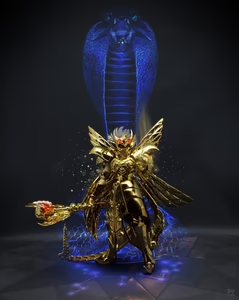
Saint Seiya
Since 1986
13th KnightGold & Silver Order
In Masami Kurumada's mythological universe, Ophiuchus occupies a doubly iconic place. First through Shaina, the formidable and tormented female Silver Knight. But above all in Next Dimension, where the myth of the 13th Gold Knight, Asclepius (or Odysseus), resurfaces, threatening the very balance of the Sanctuary.
✦ Shaina, classic representative of the silver armour
✦ Asclepius/Odysseus, the legendary 13th Gold Knight
✦ Figure of healing who became a threat to the Gods
« The thirteenth Gold Knight... the cursed man who sought to rise to the rank of god. »
Animation & Manga · Japan
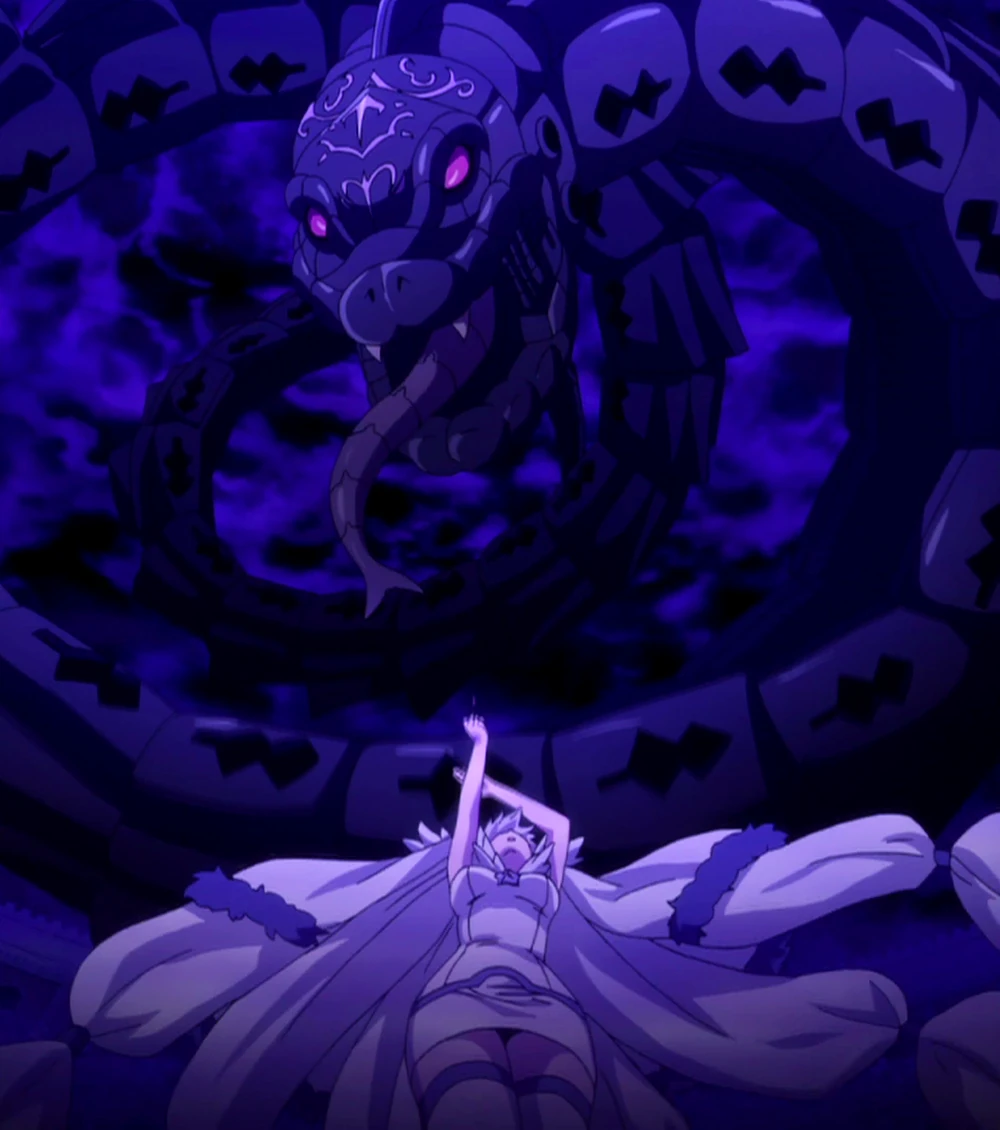
Fairy Tail
Eclipse Arc
Darkened DragonCelestial Spirit
In Fairy Tail's magical universe, the 13th gate of the Zodiac is a well-kept secret. During the Eclipse arc, Ophiuchus reveals itself in the form of an immense darkened dragon-serpent. A pure manifestation of darkness that contrasts sharply with the usual appearance of the other Celestial Spirits.
✦ The 13th secret gate of the Zodiac
✦ Appearance in the form of a shadowy dragon-serpent
✦ Ability to invoke absolute darkness
« Gate of the Snake Charmer, open! »
Experimental Film · Quebec
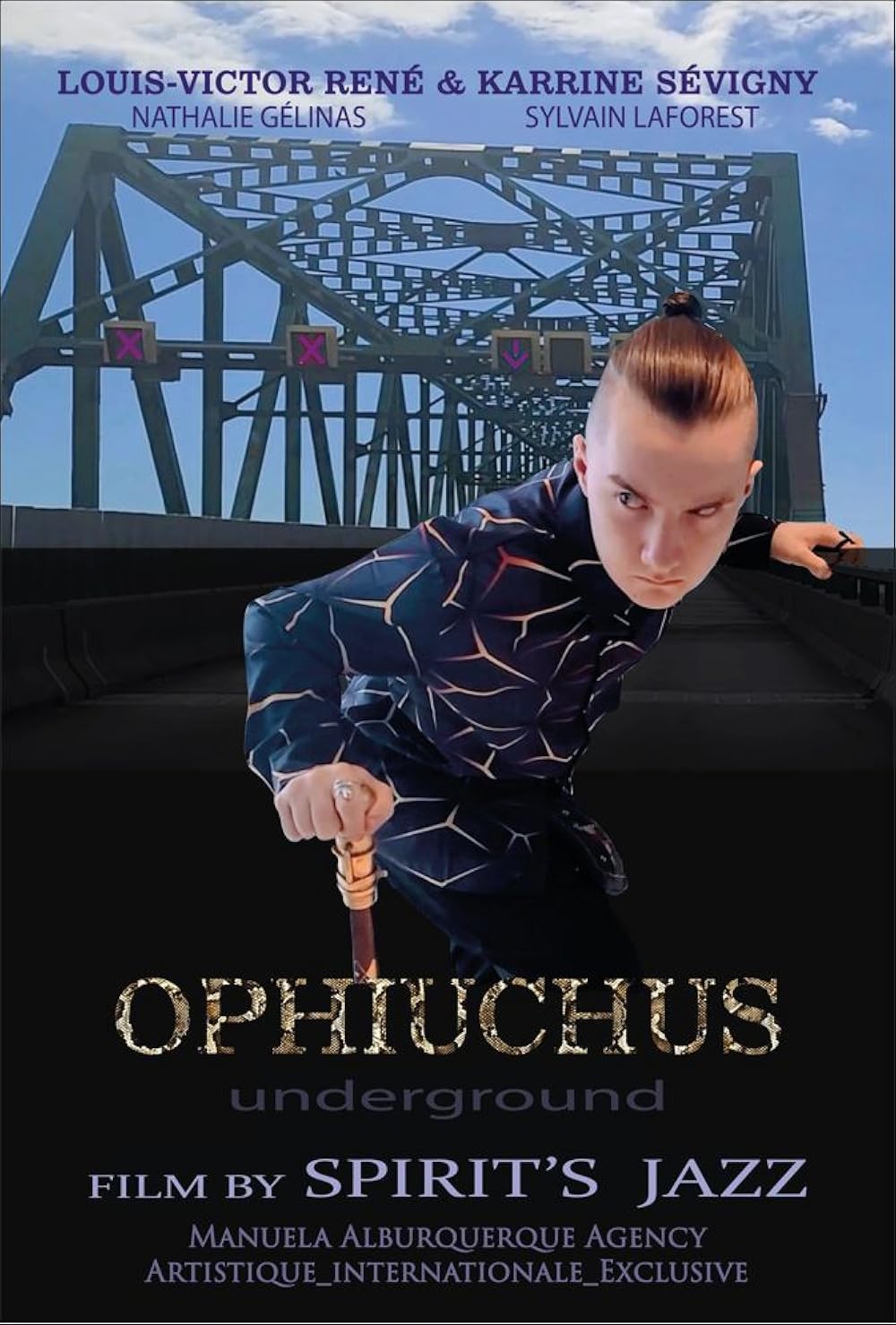
Ophiuchus Underground
Dir. Louis-Victor René
Spirit's JazzInner Quest
This Quebec experimental film (Spirit's Jazz) uses the figure of the Serpent Bearer as a central metaphor. It explores the life and struggles of a protagonist named Ophiuchus, torn in a visceral struggle between shadow and light, reflecting the duality inherent in this sign.
✦ An intimate work on the inner struggle
✦ The Shadow / Light duality at the heart of the narrative
✦ Poetic and marginal aesthetic
« A visual allegory where the serpent bearer confronts his own venom. »
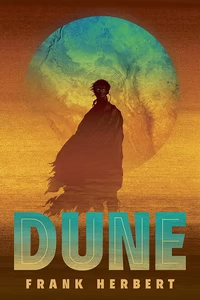
Literature & Cinema · Sci-Fi
Dune
Created by Frank Herbert
Giedi PrimeSpatial mythology
In Frank Herbert's monumental science fiction saga Dune, terrestrial constellations have survived across millennia. Ophiuchus is explicitly cited as an astronomical reference point, notably hosting the system of the star 36 Ophiuchi, birthplace of the dark planet Giedi Prime, stronghold of the brutal House Harkonnen.
✦ 36 Ophiuchi: solar system of Giedi Prime
✦ Birthplace of House Harkonnen
✦ Integration of real astronomy into worldbuilding
« Giedi Prime, a planet under a black sun, nestled in the folds of Ophiuchus. »
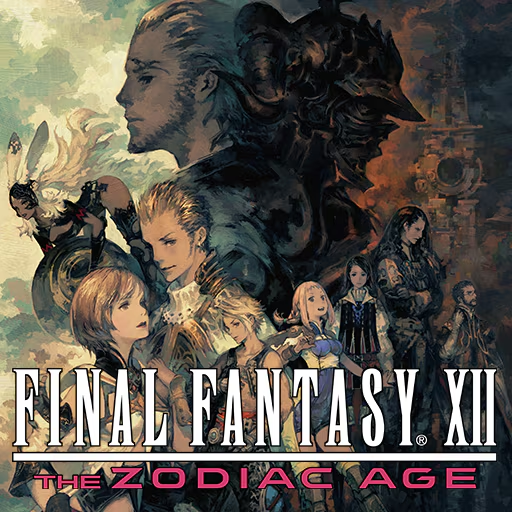
Video Game · RPG
Final Fantasy XII
2006 (Square Enix)
ZodiarkThe Darkness Esper
In the mythology of Ivalice, the summonable powers (the Espers) correspond to the signs of the Zodiac. Zodiark is the 13th Esper, the Esper of Darkness, associated with the Serpent Bearer. It is reputed to be so powerful that the Gods themselves, terrified by its strength, sealed it away when it was still a child.
✦ Representation of Ophiuchus as the 13th summon
✦ Absolute master of the universe's darkness
✦ The most formidable secret boss in the game
« The child of the gods, whose power was so great that they feared it and locked it away. »
✦
Conclusion — Has the horoscope been wrong from the start?
It is not your horoscope that changes. It is your perspective.
I do not want to destroy astrology. I want to restore its complexity.
The 12 zodiac signs are part of a symbolic system that can no longer claim to read the stars. Because it decided, 2,500 years ago, that certain stars did not count.[4]
The ultimate tool of astronomers
To calculate events over millennia without making mistakes in calendar reforms (deleted days, variable leap years), modern astronomers use the Julian Day (JD). Created in 1583 by Joseph Scaliger, this system abandons months and years for a simple continuous day counter.
The starting point (day 0) was mathematically fixed at 1 January 4713 BC, the date on which three great chronological cycles (solar, lunar and indiction) synchronise perfectly. To this day, more than 2,461,115 days have elapsed, offering a pure timeline without calculation errors.
Real-time Astronomical Clock
Today is ... Current Julian Day:...
The Serpent Bearer is the grain of sand in the machinery. It forces us to admit that the sky changes, that constellations shift, that our mental maps of the cosmos, however reassuring they may be, are limited by our discoveries.
« There is always a hidden star behind what we believe we know. It is this mystery that nourishes an honest astrology — one that connects science and symbolism, rigour and poetry, to better illuminate the path. »
I embrace my nature as Ophiuchus. It is not the sky that has changed since I began exploring it. It is I who have stopped looking only at what I was authorised to see.
Sources & references
1
Ptolemy, Claudius — Almagest, 2nd century ADFounding catalogue of 48 constellations, including Ophiuchus. Astronomical reference of late Antiquity and the Middle Ages.
2
Allen, Richard Hinckley — Star Names: Their Lore and Meaning, G.E. Stechert, New York, 1899Exhaustive reference on the etymology and mythology of stars and constellations, including Ophiuchus and its identification with Asclepius.
3
NASA / International Astronomical Union — Official data on ecliptic constellationsDocumentation of the 88 official constellations and confirmation that Ophiuchus is crossed by the ecliptic between November 30th and December 18th.
4
Van der Waerden, Bartel L. — Science Awakening II: The Birth of Astronomy, Springer, 1974Historical analysis of Babylonian astronomical systems and the choice of the 12-sign zodiac, documenting the exclusion of Ophiuchus.
5
Jung, Carl Gustav — Psychology and Alchemy, Rascher Verlag, 1944Reference on the archetype of the wounded healer and the symbolism of alchemical transformation, applied here to the archetype of Ophiuchus.
 Français
 English
 Português
 Español